The ZARATHUSTRA project is approaching its end, and with it, the last of its results are coming about. Several new papers and datasets have been published, and yet others are in different stages of peer-review. All of them can be found in the Results tab of this website.
What are these works about?
- “Fully-implicit Particle-in-Cell model of a Magnetic Nozzle with electromagnetic power deposition“ A 1D3V implicit PIC study of right-hand polarized waves in a magnetic nozzle, showing that electron heating near the cyclotron resonance surface creates anisotropy that enhances ion acceleration, but nozzle efficiency degrades beyond a threshold wave power.
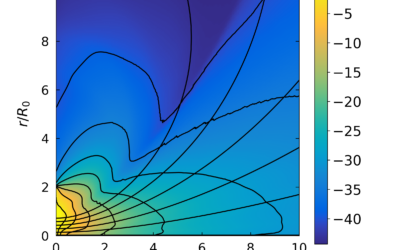
- “Analysis of collisional and facility effects in a magnetic nozzle plasma expansion“An axisymmetric three-fluid model of plasma expansion in a magnetic nozzle showing that electron cooling in the plume arises naturally from convective energy flux, without invoking anomalous resistivity, and that collisions do not qualitatively alter the results of collisionless models.
- “Plasma plume characterization of an electrodeless thruster cluster in magnetic arch configuration” Experimental characterization of two clustered ECR thrusters arranged in a closed magnetic arch configuration, showing that a plasma jet can still be extracted despite reduced ion energy, and that plume deflection direction depends on the applied magnetic field due to lateral electron drifts
- “Azimuthal mode decomposition Particle in Cell algorithm for cylindrical plasma sources” A Particle-in-Cell method for cylindrical low-temperature plasma sources that uses Fourier decomposition in the azimuthal direction, reducing the field solve to lower-dimensional problems and achieving about a tenfold speedup over standard 2D PIC codes
- “On Spurious Mesh-Scale Oscillations Associated with Resonance-Cone Regimes in Wave-Plasma Simulations” Spurious oscillations in finite-element wave-plasma simulations are linked to resonance-cone regimes, where the governing equation loses ellipticity. Mesh irregularities trigger coupling to additional wavevector components, while uniform rectangular grids recover the correct solution