
On the ground, the plume in a magnetic nozzle interacts with background gas and with
the chamber walls. To study this, we extended our DIMAGNO-DG code to a three-fluid
model (ions, electrons, and neutrals) that includes in-plume ionization, background
pressure, and the electrical connection between the thruster and the chamber. Main
takeaways:
- Moderate collisions don’t change the core physics: the ambipolar field converts
electron thermal energy into ion kinetic energy, and the magnetic nozzle
produces significant magnetic thrust. - Ionization in the plume adds ion mass flow and thrust, but it cools the electrons,
slows the mean ion velocity, and widens the plume. - Boundary conditions matter much: only a floating-wall condition at the plume
boundary reproduces the slight drop in thrust with background pressure reported
in experiments. - The convective electron energy closure of our model captures the plume cooling
seen in experiments, without adding any empirical anomalous transport.
Analysis of collisional and facility effects in a magnetic nozzle plasma expansion
Manuel Cortés-Hernán, Mario Merino, Diego García-Lahuerta and Eduardo Ahedo
Physics of Plasmas, AIP Publishing
https://doi.org/10.1063/5.0351676
Open-access version: https://arxiv.org/abs/2607.07861
DIMAGNO-DG: https://github.com/MCortesHernan/DIMAGNO-DG
This work has been carried out as part of the ZARATHUSTRA project, with funding from
the European Research Council (ERC). Additional support came from R&D Project
PID2023-150052OB-I00 (ADAPT) and Project PID2022-140035OB-I00 (HEEP), funded
by Agencia Estatal de Investigation. The Department of Aerospace Engineering at
UC3M is a “María de Maeztu” Unit of Excellence.
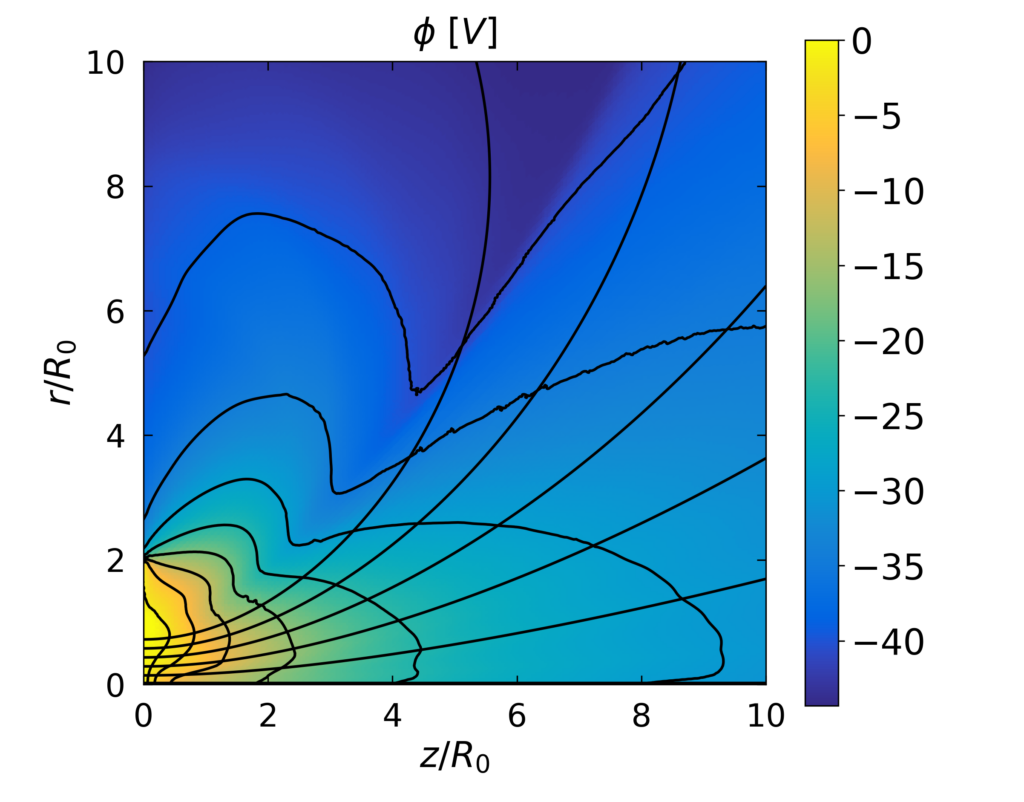
*Image Description
The included figure depicts the electrostatic potential of the plume under a non-ideal
plasma expansion with neutrals being emitted by the thruster under the effects of
collisions between species.


