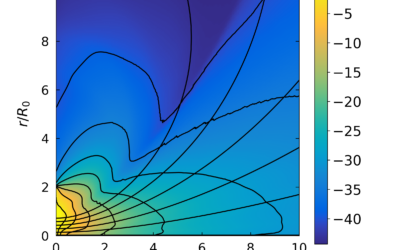
Check out the new review co-authored by ZARATHUSTRA Principal Investigator Mario Merino, “Kinetic electron cooling in magnetic nozzles: experiments and modeling”.
The publication is a collaboration between researchers from Seoul National University, Tohoku University, and Universidad Carlos III de Madrid. It sums up the state-of-the-art advances in the kinetic point of view surrounding the magnetic nozzle of electrodeless plasma thrusters, as well as maps out the future challenges of the field. You can access it freely on the publisher’s website.

Abstract
As long-distance space travel requires propulsion systems with greater operational flexibility and lifetimes, there is a growing interest in electrodeless plasma thrusters that offer the opportunity for improved scalability, larger throttleability, running on different propellants and limited device erosion. The majority of electrodeless designs rely on a magnetic nozzle (MN) for the acceleration of the plasma, which has the advantage of utilizing the expanding electrons to neutralize the ion beam without the additional installation of a cathode. The plasma expansion in the MN is nearly collisionless, and a fluid description of electrons requires a non-trivial closure relation. Kinetic electron effects and in particular electron cooling play a crucial role in various physical phenomena, such as energy balance, ion acceleration, and particle detachment. Based on experimental and theoretical studies conducted in recognition of this importance, the fundamental physics of the electron-cooling mechanism revealed in MNs and magnetically expanding plasmas is reviewed. In particular, recent approaches from the kinetic point of view are discussed, and our perspective on the future challenges of electron cooling and the relevant physical subject of MN is presented.