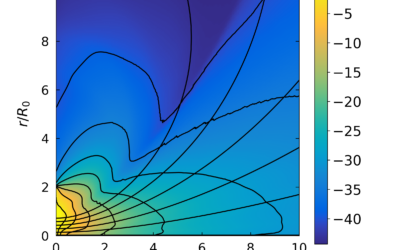
We are happy to announce yet another paper! “Drift-gradient instabilities in a plasma with 2D gradient effects: Application to a magnetic nozzle”, authored by Matteo Ripoli, Eduardo Ahedo, and Mario Merino was published on Physics of Plasmas.
You can find the Open Access paper here, as well as the data set here.
Abstract
Instabilities common to E x B partially magnetized plasmas can ultimately lead to anomalous electron cross-field transport. This work presents a local linear analysis of fluid instabilities driven by the electron E x B drift and gradients in the equilibrium magnitudes of an essentially collisionless plasma. Effects of magnetic curvature, finite electron Larmor radius, and 3D wave propagation are included. Expanding on previous works, the role of gradients both perpendicular and parallel to the magnetic field is analyzed. The analysis of the dispersion relation for the complex frequency of the modes shows that a generalization of the classical lower-hybrid drift instability (LHDI) develops when parallel gradients or parallel propagation are accounted for. Furthermore, this LHDI becomes a generalized modified two-stream instability when perpendicular gradients are absent. Weak collisionality can reduce or enhance the growth rate of the collisionless LHDI, depending on the parametric range of parallel effects. The application of the LHDI dispersion relation to the simulation data of a magnetic nozzle plasma at equilibrium highlights the importance of parallel inhomogeneities in the instability developing in certain nozzle regions. The qualitative agreement with available experimental data on magnetic nozzles is discussed, too. Finally, quasi-linear analysis suggests that the LHDI-induced cross-field transport in the outward direction acts to smooth out the zeroth-order drifts which cause the plasma to destabilize in the first place, and may be an essential mechanism partaking in electron detachment from a magnetic nozzle.